
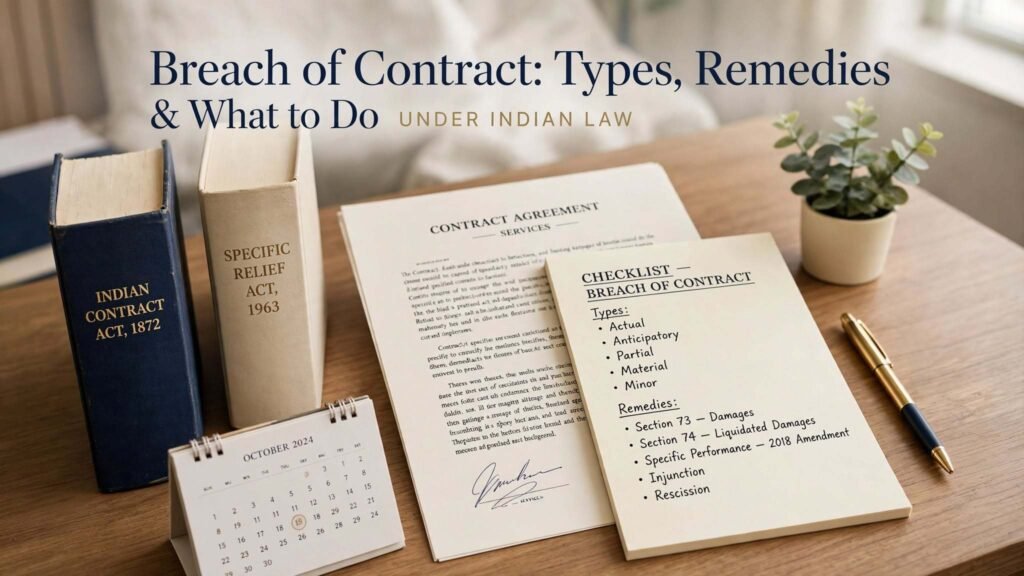
Breach of contract in India costs most people more than the disputed amount, because the first few days decide how much of your money and leverage you keep. A supplier stops answering calls after taking your advance. A client says “payment next week” for the fourth month running. A co-founder walks out with the customer list. A contractor abandons the site at 60% completion. Every one of these is a breach of contract.
This guide covers what counts as a breach of contract under Indian law, the different types, the remedies you can ask a court or arbitrator for, and a step-by-step plan for what to do. It also covers the parts most articles skip: whether you must try mediation before filing, how long you have to sue, why a liquidated damages clause may not give you the full amount, and how the 2018 change to the Specific Relief Act altered your options.
The short version. A breach of contract happens when a party fails, without lawful excuse, to do what the contract requires, or makes it clear they will not. The usual remedy is money, under Section 73 of the Indian Contract Act, 1872. In some cases you can ask the court to force performance, stop the other side from doing something, or cancel the contract and recover what you paid. You have three years to sue in most cases. For many commercial disputes you must try mediation first.
What counts as a breach of contract
Section 37 of the Contract Act says the parties must perform their promises or offer to perform them, unless performance is excused by law. A breach of contract is the failure to do that, with no valid excuse. To make a claim stick, you generally have to show four things:
- A valid and enforceable contract exists, written or oral, signed or exchanged by email.
- You performed your side, or were ready and willing to.
- The other party failed to perform, or refused in advance.
- You suffered loss, or you are asking for a remedy that does not depend on loss, such as specific performance.
People often miss the second point. If you are in breach yourself, say you delivered late and then complain about late payment, the other side will use it. In any breach of contract case, courts look at both sides’ conduct.
What is not a breach of contract
Some failures are excused. Section 56 deals with impossibility and frustration. A contract becomes void when an event makes performance impossible or unlawful, for example a law that bans the goods you promised to supply. The Supreme Court has repeatedly said that commercial hardship is not enough. A contract that has become more expensive or less profitable is still a contract. Many agreements also carry a force majeure clause, and what it covers depends entirely on its wording, so read it before you rely on it or are met with it.
Types of breach of contract
There is no single official classification of breach of contract, so lawyers sort breaches along a few different lines. This table covers the ones that matter in practice.
| Type | What it means | Example | Why it matters |
|---|---|---|---|
| Actual breach | Failure to perform on or after the due date | The vendor does not deliver on 15 November as promised | You can claim immediately |
| Anticipatory breach | One party says or shows, before the due date, that they will not perform | The builder writes that he will not hand over the flat on the agreed date | Section 39 lets you end the contract and claim damages at once, or wait until the due date |
| Partial or defective performance | The work is done, but incomplete or below the agreed standard | Software delivered with half the features | You may be able to claim for the shortfall without ending the contract |
| Material breach | A failure that goes to the root of the deal | A seller delivers a different product | May justify termination |
| Minor breach | A small deviation that does not defeat the purpose | Delivery one day late where time is not essential | Damages only, and you may not be able to terminate |
| Breach of a negative covenant | Doing something the contract forbids | Disclosing confidential information, or soliciting clients | Injunction is often the main remedy |
| Breach by prevention | One party stops the other from performing | A client refuses site access, so the contractor cannot finish | Section 53 gives the innocent party options |
| Breach of warranty or representation | A statement in the contract turns out false | The seller warrants no pending litigation, and there is some | Damages, and possibly rescission |
Two points trip people up in breach of contract disputes. The first is time. Under Section 55, if time is “of the essence”, a late performance lets the other side cancel the contract. If it is not, lateness alone gives you damages. Courts look at the wording and the nature of the deal, and they tend to read time as essential only where the contract clearly makes it so. The second is anticipatory breach. You have a choice. You can accept the refusal, treat the contract as over and sue, or you can keep the contract alive and wait. Waiting can backfire. If the contract is later frustrated, or you fail to reduce your loss, you may recover less.
Remedies for breach of contract
Indian law gives you several remedies for breach of contract. They are not alternatives you pick at random. Each fits particular situations.
| Remedy | Source | Use it when | The catch |
|---|---|---|---|
| Compensatory damages | Section 73, Contract Act | Money is enough to put you right | Only natural and foreseeable loss, minus what you could have avoided |
| Liquidated damages or penalty | Section 74, Contract Act | The contract fixes the amount | You get reasonable compensation, capped at the stated sum |
| Specific performance | Specific Relief Act, 1963 (as amended in 2018) | The subject matter is unique, such as land | Not for contracts a court cannot supervise or that are determinable |
| Injunction | Specific Relief Act, 1963 | You need the other party stopped | Courts weigh urgency and balance of convenience |
| Rescission and restitution | Sections 53, 54, 64 and 75, Contract Act | You want out and want your money back | You must return what you received |
| Quantum meruit | Section 70, Contract Act | You did work and the contract fell apart | You recover a reasonable value for the work |
| Interest | Contract, Interest Act, 1978, CPC and MSMED Act | Money was delayed | Rate depends on the source |
Damages for breach of contract under Section 73
The rule is simple to state. You get compensation for loss that arose naturally from the breach of contract, or that both sides knew was likely when they made the contract. You do not get compensation for remote or indirect loss. This is the old English rule in Hadley v. Baxendale, written into the Indian statute. There is also a duty to reduce your loss. If you could have bought replacement goods at a lower price and did not, the court can reduce your award by that avoidable amount.
Here is how the arithmetic usually goes. You agree to buy 500 units at ₹800 each, total ₹4,00,000. The seller fails to deliver. You buy 500 units elsewhere at ₹950, total ₹4,75,000, plus ₹6,000 extra transport. Your direct loss is ₹75,000 for the price difference plus ₹6,000, so ₹81,000. If you could have found the same units at ₹900 and chose to pay ₹950, the court will probably measure your loss against ₹900 and not ₹950. If you also lost a resale deal worth ₹40,000 in profit, you can claim that only if the seller knew about the resale deal when you contracted. Keep invoices, quotes, and emails showing what you did to limit the loss, because you will need them.
Courts do not award damages for mental distress in ordinary commercial contracts, and punitive damages are rare.
Liquidated damages and penalties under Section 74
Most commercial contracts say something like “₹10,000 per day of delay, capped at 10% of contract value.” Many founders assume that sum is automatic. It is not.
Section 74 says the injured party is entitled to “reasonable compensation not exceeding the amount so named”. Over the years the Supreme Court has refined this. Fateh Chand v. Balkishan Dass (1963) held that the section removes the need to prove actual loss in some cases but gives no right to compensation where no legal injury occurred. ONGC v. Saw Pipes (2003) said a genuine pre-estimate can be enforced without proof of loss where loss is hard to prove. Then Kailash Nath Associates v. Delhi Development Authority (2015) tightened it: loss or damage is a necessary condition, and the stated sum is a ceiling, not a floor.
The trend continues. A Delhi High Court division bench held in 2023, in a builder and owner dispute, that a party relying on a liquidated damages or penalty clause must plead and prove the loss it suffered. An analysis in SCC Online in July 2026 reports Delhi High Court decisions in 2025 and 2026 that refuse to treat the clause amount as automatic, and calls the clause a “ceiling, and not a floor”. In practice:
- Record, at the time of drafting, how you arrived at the figure, so you can show it was a genuine estimate.
- Keep records of the actual loss, such as extra rent, idle staff or replacement cost.
- Do not deduct liquidated damages from the other side’s dues unilaterally. Courts have criticised set-off without adjudication.
Specific performance after the 2018 amendment
Before 2018, a court hearing a breach of contract claim could order specific performance in its discretion, and it often declined. The Specific Relief (Amendment) Act, 2018 changed Section 10 so that specific performance “shall be enforced”, subject to a short list of exceptions. Section 14 now limits those exceptions to contracts where substituted performance has been obtained, contracts that need continuous supervision, contracts that depend on personal qualifications, and contracts that are determinable.
Two practical points follow. You still have to show you were ready and willing to perform your own part. And the amendment introduced “substituted performance” under Section 20. If the other party defaults, you can give written notice of at least 30 days, get the work done through a third party or your own agency, and recover the cost you actually incurred. Once you choose this route, you cannot also seek specific performance, though your claim for compensation stays. For a business that needs the job finished and not litigated, this is often the most useful change in the Act.
Injunction, rescission and quantum meruit
An injunction fits a breach of contract where someone does what they promised not to do: sharing trade secrets, selling under your brand, or breaching exclusivity. Our guide to trade secret protection in India shows how courts handle this. Rescission cancels the contract and, under Section 75, lets the innocent party claim compensation too. If you paid an advance, you can ask for it back together with interest. If you did part of the work and the contract collapsed, Section 70 and the quantum meruit principle can give you the reasonable value of that work.
If you are a small supplier waiting for payment
The Micro, Small and Medium Enterprises Development Act, 2006 has its own rule for delayed payment to micro and small suppliers. Payment is due within the agreed period, not exceeding 45 days from acceptance of goods or services. After that, the buyer owes interest at three times the bank rate notified by the RBI. Disputes go to the state Micro and Small Enterprise Facilitation Council through the MSME Samadhaan portal, and councils are expected to decide cases within about 90 days. Whether your Udyam registration must predate the contract is a point courts have examined, so register early. Our guide to MSME registration explains how.
What to do after a breach of contract: a step-by-step plan
Do these in order.
1. Read the contract before you write anything. Look for the termination clause, any notice or cure period, the governing law, the dispute resolution clause, interest on late payment, liquidated damages and limitation of liability. Many people send an angry email that breaks a notice requirement in the contract.
2. Build the file. Gather the contract and all amendments, purchase orders, invoices, delivery proofs, emails, WhatsApp messages, call logs and payment records. Write a dated timeline. Save the originals. If a payment promise exists in writing, keep it carefully, because a signed written acknowledgment of liability restarts the limitation clock under Section 18 of the Limitation Act.
3. Decide whether to keep the contract alive or end it. This is the decision that most often goes wrong after a breach of contract. If you terminate when you had no right to, you become the party in breach. If the breach is serious and the contract gives you a termination right, follow its notice steps exactly. If the breach is minor, claim damages and keep performing.
4. Reduce your loss. Find a substitute supplier, redeploy staff, or invoice what is due. Document each step. This is both a legal duty and your best evidence.
5. Send a legal notice. A notice is not required before suing a private party for breach of contract, but it is almost always worth sending. It records the facts, fixes the date of the demand, puts the other side on notice of interest and costs, and often prompts a settlement. If the other side is the government, a statutory notice under Section 80 of the CPC is required before a civil suit. A good breach of contract notice states:
- The parties, the contract and its date
- The specific clauses breached, and how
- What you did to perform
- The amount demanded, with the calculation and interest
- A deadline, commonly 15 days
- A statement that you will pursue arbitration or court action without further notice, and that all rights are reserved
Keep the tone plain. Do not exaggerate, do not threaten criminal action to force a civil payment, and do not admit anything you do not need to. If a cheque bounced, a separate statutory route applies, which our guide to the cheque bounce notice covers.
6. Try mediation, and check whether the law requires it. Under Section 12A of the Commercial Courts Act, 2015, a commercial suit generally cannot be filed without first attempting pre-institution mediation, unless the suit contemplates urgent interim relief. The Supreme Court held in Patil Automation v. Rakheja Engineers (2022) that this is mandatory, and a plaint filed without it can be rejected. The mediation must be completed within three months, extendable by two more with the parties’ consent, and the time spent is excluded from limitation. Courts have read the “urgent relief” exception differently, so do not assume it applies because you filed an interim application.
7. Choose the forum. If your contract has an arbitration clause, that decides where a breach of contract claim goes. You file under the Arbitration and Conciliation Act, 1996, and you can ask a court for interim protection under Section 9 while the arbitration proceeds. If there is no arbitration clause, a commercial dispute above the specified value goes to a commercial court, and others go to the civil court. Where you are owed a fixed sum under a written contract, a summary suit may be available, which is faster than a full trial. Ask your lawyer which applies, because the choice affects cost and speed.
8. Mind the limitation period. For compensation for breach of contract, Article 55 of the Limitation Act, 1963 gives three years from when the contract is broken. For specific performance, Article 54 gives three years from the date fixed for performance, or from when you learn the other party refuses. Parties cannot extend limitation by agreement, and a clause shortening it is invalid. A signed written acknowledgment before the period ends gives a fresh three years from that date. A debt that is time-barred is not wiped out, but a court will not enforce it, and the other side can raise the point. Do not wait out of politeness.
Which remedy fits which breach of contract
| Your situation | Likely best route |
|---|---|
| Customer owes an invoice and has not paid | Legal notice, then summary suit or arbitration; interest if the contract provides |
| Small supplier unpaid for over 45 days by a buyer | MSMED interest and the Facilitation Council |
| Supplier did not deliver goods you can buy elsewhere | Buy replacement, claim the price difference under Section 73 |
| Seller of land or a unique asset refuses to complete | Specific performance, plus compensation |
| Ex-partner or employee is using confidential data | Urgent injunction, with arbitration or suit to follow |
| Builder or contractor abandons work you need finished | Substituted performance under Section 20, or damages |
| Other side says they will not perform before the due date | Accept the repudiation and sue, or wait, after weighing the risk |
| You paid an advance and the deal collapsed | Refund with interest, under rescission principles |
Drafting so a breach of contract costs less
Most expensive breach of contract disputes were visible in the contract before anyone signed it. Check for:
- A clear payment date and interest on late payment.
- A notice and cure period, so you know when a breach can become termination.
- Liquidated damages with a recorded basis, set at a sensible and defensible level.
- A limitation of liability clause that fits the deal.
- An arbitration clause with a named seat, number of arbitrators and rules, or an exclusive court jurisdiction clause.
- A force majeure clause that lists the events and the procedure.
- Proper stamping. An unstamped contract cannot be relied on until duty and penalty are paid.
If these terms are unfamiliar, our contract law glossary explains them plainly. Freelancers and agencies will find the clauses that matter most in our guide to freelance agreement clauses, and if a client has simply stopped paying, what to do when a client refuses to pay covers the recovery route. Property owners and tenants should read the commercial lease agreement guide, where breach, lock-in and notice terms are what end up in court. If you built your business around a partnership, the partnership deed versus LLP agreement comparison explains how liability for breach differs.
Founders working with AI vendors should note that indemnity gaps are a breach of contract issue waiting to happen. We cover that in the AI indemnity trap.
Mistakes that weaken a breach of contract claim
- Accepting late performance without a word. If you keep accepting deliveries or payments after the deadline with no reservation, the other side will say you waived the right to complain. Reserve your rights in writing.
- Terminating without a right. It flips the roles and exposes you to a claim.
- Doing nothing about loss. The court will subtract what you could have avoided.
- Ignoring the arbitration clause. A suit filed in the wrong forum wastes months.
- Skipping Section 12A. Your plaint can be thrown out.
- Waiting too long. Three years pass faster than people expect.
- Writing emotional messages. Every email can be filed as evidence. Assume a judge will read it.
- Spending more than you can recover. Before you start, check whether the other side can actually pay.
On that last point, the cost and delay of a breach of contract suit are real. Our piece on third-party litigation funding in India explains one option for funding a strong claim, and its limits. If your claim involves a personal guarantee given by a founder, read the personal guarantor trap before you take a position.
If you want a notice drafted, a contract reviewed before you sign, or a view on whether to sue, you can get in touch, and the startup legal section lists related guides.
Frequently asked questions
1. What is breach of contract?
A breach of contract is a failure, without lawful excuse, to perform a promise made in a valid contract, or a clear refusal to perform it. It can be non-payment, non-delivery, late or defective performance, breach of a restriction, or a refusal before the due date. Section 37 of the Indian Contract Act says parties must perform their promises unless the law excuses them.
2. What are the main types of breach of contract?
The main types are actual breach, anticipatory breach, partial or defective performance, material and minor breach, breach of a negative covenant, breach by prevention, and breach of warranty or representation. The type of breach of contract affects your remedy. A material breach can justify termination. A minor one usually supports damages only.
3. What is anticipatory breach of contract?
It happens when one party says or shows, before performance is due, that they will not perform. Section 39 of the Contract Act lets the other party treat the contract as ended and claim damages immediately, or keep the contract alive and wait for the due date. Waiting carries the risk that your loss becomes harder to prove or that the contract is later frustrated.
4. What remedies are available for breach of contract in India?
Compensatory damages under Section 73, liquidated damages under Section 74, specific performance and injunction under the Specific Relief Act, rescission and restitution under Sections 53, 54 and 75, quantum meruit under Section 70, and interest. Micro and small suppliers have an additional route for delayed payment under the MSMED Act.
5. How much compensation can I claim for breach of contract?
You can claim loss that arose naturally from the breach, or that both parties knew was likely when the contract was made, less any loss you could have avoided. Remote and indirect loss is excluded. Where the contract states liquidated damages, you get reasonable compensation up to that sum, and courts increasingly expect proof of actual loss.
6. Is a legal notice compulsory before suing for breach of contract?
For a private party, no. It is strongly advisable, because it records your demand and sets a deadline. For a suit against the government, a notice under Section 80 of the CPC is required. For commercial disputes, mediation under Section 12A is a separate requirement, unless the suit contemplates urgent interim relief.
7. How long do I have to file a suit for breach of contract?
Generally three years. Article 55 of the Limitation Act, 1963 covers compensation and runs from the breach. Article 54 covers specific performance and runs from the date fixed for performance. A signed written acknowledgment of liability starts a fresh period. Time spent in pre-institution mediation under Section 12A is excluded.
8. Can I terminate a contract after a breach of contract?
Only if the breach is serious enough, or the contract gives you a termination right, and you follow its notice process. If you terminate without a right, you may be the one in breach. For a minor breach, you will usually keep performing and claim damages.
9. Can I claim damages for mental harassment in a commercial breach of contract?
Rarely. Courts compensate contractual loss and do not generally award damages for distress in ordinary commercial contracts. Exceptions are narrow and fact-specific. Claim what you can prove: lost money, replacement cost, lost profit within the foreseeability rule, and interest.
10. Do I need an arbitration clause or can I go to court?
If your contract has a valid arbitration clause, you must use arbitration, though you can seek interim protection from a court under Section 9. If it has none, you file in the competent court, and commercial disputes have the extra step of pre-institution mediation. Check the clause before you take any other step.
This article is general information, not legal advice. Rules, thresholds and case law change, and the right step depends on your contract and facts. Speak to a qualified lawyer before you send a notice or file a claim.