
The MOU vs contract question has a one-line answer that surprises people: in India, the name on top of the page decides almost nothing.
A memorandum of understanding that shows an intention to be bound, with settled terms and something exchanged for it, is a contract, however politely it is titled. A “contract” that leaves the price, the delivery and the exit for later is, in practice, a hope. Courts read what the parties wrote and did, and they do not much care what the document called itself. That is the whole MOU vs contract test in one line.
This article sorts out the MOU vs contract confusion properly: what each document is meant to do, what the Indian Contract Act and the Supreme Court say about when a preliminary document binds, how a letter of intent differs from an MOU, what happens with stamp duty and registration, and how to draft a document so that it binds on the points you want and nothing else. There are sample clauses and a short list of mistakes I see founders make, usually after money has already moved.
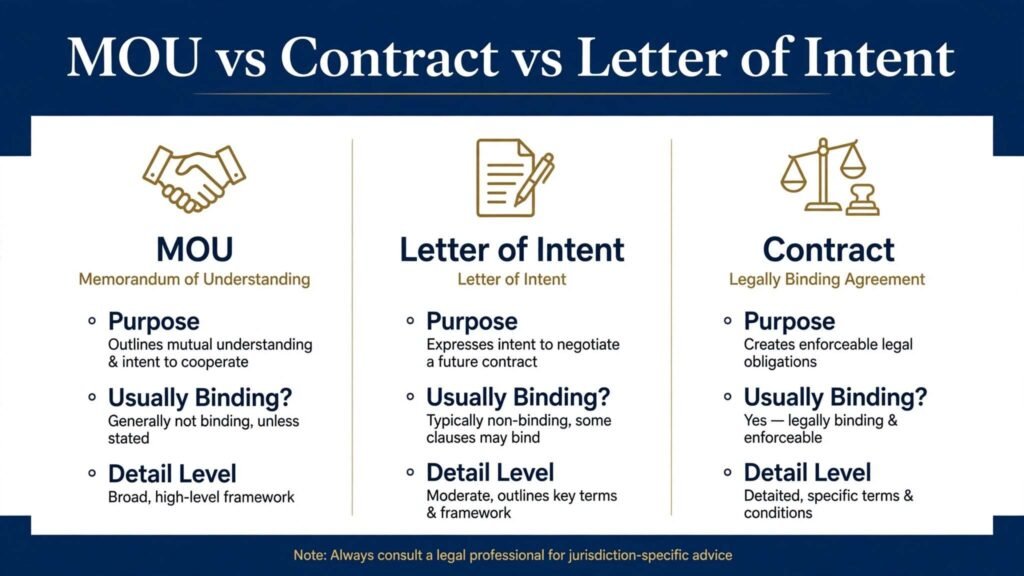
MOU vs contract: the quick comparison
| MOU | Letter of intent (LoI) | Term sheet | Contract | |
|---|---|---|---|---|
| Main purpose | Record a shared understanding or framework | Signal serious intent to proceed, often one-sided | Summarise key commercial terms of a deal | Create enforceable rights and duties |
| Usually binding? | Depends on wording and conduct | Usually not, with exceptions | Usually not, apart from specific clauses | Yes, if the Contract Act requirements are met |
| Detail level | Medium; often general | Low to medium | Medium; focused on economics | High; complete terms |
| Typical binding parts | Confidentiality, exclusivity, governing law, costs | Confidentiality, exclusivity | Confidentiality, exclusivity | Everything |
| Typical users | Partners, institutions, governments, co-founders | Buyers, investors, employers, tender authorities | Investors and founders | Anyone |
| Stamp duty | Depends on the state and the content | Depends on the state and the content | Usually none if unsigned and non-binding | Yes, on the instrument |
The “usually binding?” row is where the confusion lives. In any real MOU vs contract dispute, that is the row the other side’s lawyer will read first.
MOU vs contract: what makes any document a contract in India
Section 2(h) of the Indian Contract Act, 1872, defines a contract as an agreement enforceable by law. Section 10 lists what makes an agreement enforceable: free consent of parties competent to contract, a lawful consideration and a lawful object, and it must not be expressly declared void. Underneath those words, courts ask one more question that is not in the section but runs through the case law: did the parties intend to create legal relations?
Add a fifth test from Section 29. An agreement whose meaning is not certain, or is not capable of being made certain, is void. This is the section that kills most “agreements to agree” and most badly drafted MOUs.
So when someone asks me the MOU vs contract question, I turn it into four smaller questions:
- Did the parties intend to be bound, judged from the words, the surrounding circumstances and what they did afterwards?
- Are the essential terms complete and certain (parties, subject matter, price or a way to fix it, time)?
- Is there consideration?
- Is anything essential left for a future agreement, and if so, was that future agreement a condition of the deal or only a formality?
The last question is the one that decides most disputes.
The future contract problem
In Kollipara Sriramulu v. T. Aswatha Narayana (AIR 1968 SC 1028), the Supreme Court said that where a document says a formal contract will follow, it is a question of construction whether the formal contract is a condition of the bargain (so there is no contract until it is signed) or only a record of how an agreed deal will be carried out (so the deal already exists). The mere words “a formal agreement shall be executed” do not settle it.
That means an MOU saying “the parties will enter into a definitive agreement” can still be a contract, and an MOU that has all the terms but says “this is not binding” is usually not. The wording matters, but it is evidence, not a magic spell. That is why MOU vs contract is a question about words and conduct, not the heading.
MOU vs contract in the courts: how MOUs have been treated
On MOU vs contract, there is no single Supreme Court judgment that says “an MOU is binding” or “an MOU is not binding”, and anyone telling you there is, is selling something. The pattern across the cases is more useful.
MOU treated as binding, usually because of conduct and completeness
- Jai Beverages v. State of Jammu and Kashmir (Supreme Court): an MOU on industrial incentives was held binding because the parties had performed and taken benefits under it (as described in competitor commentary).
- K.K. Modi v. K.N. Modi (Supreme Court, 1998): an MOU recording a family arrangement and containing a dispute-resolution clause was treated as operative and acted on.
- Trimex International v. Vedanta Aluminium (Supreme Court, 2010): a concluded contract was found in an exchange of correspondence, and the fact that a formal contract had not been signed or initialled did not undo it.
- Ksl & Industries v. National Textiles (Delhi High Court, 2012): an MOU was prima facie binding because it said it created binding obligations.
- Andritz Oy v. Enmas Engineering (Madras High Court, 2007): a party that had taken the benefit of an MOU could not later deny it.
MOU or letter treated as non-binding
- Rickmers Verwaltung v. Indian Oil Corporation ((1999) 1 SCC 1, Supreme Court): correspondence showing only negotiation, with the material terms not agreed, did not make a concluded contract.
- J.K. Rajgarhia v. Dr. Ravi Singh (Delhi High Court, 1995): the court questioned what value an MOU “subject to mutual agreement” could have.
- Monnet Ispat v. Union of India (Supreme Court, 2012): an MOU was not a binding contract for the purposes of Article 299, which governs government contracts (as cited in a consumer case).
I have taken several of these from secondary summaries, so read the judgments before you cite them. On MOU vs contract, the direction of travel is not in doubt: conduct and completeness beat labels.
The “non-binding” label in an MOU vs contract fight
If you want an MOU not to bind, say so in plain words, and then behave consistently. A document that says “this MOU is not legally binding” and is then followed by a payment, a handover of the site, and the other side starting work looks very different from the label. Courts have found contracts from such conduct. The label helps. It does not immunise you.
MOU vs contract vs LoI: how a letter of intent differs
A letter of intent is usually one party’s statement that it intends to enter into a transaction on described terms. It is common in acquisitions, real estate, hiring, investment, and public procurement. The Supreme Court has said repeatedly that it is generally not a binding contract, but the exception is where the words and conduct show it was meant to be an acceptance.
The cases give you the rule in three steps.
- Dresser Rand S.A. v. Bindal Agro Chem (Supreme Court, 2006). Letters of intent that did not incorporate an arbitration clause and did not show the parties agreeing on the same terms did not create a binding arbitration agreement without a final purchase order. The Court set out that an LoI generally signals future intent and is not binding, but can operate as an acceptance if its language is clear, material terms are settled and the parties act on it.
- Rajasthan Co-operative Dairy Federation v. Maha Laxmi Mingrate Marketing Service (Supreme Court, 1996). The LoI was a condition precedent to a distribution agreement. Without the bank guarantee the LoI required, no contract arose.
- South Eastern Coalfields v. S. Kumar’s Associates (Supreme Court, 2021). A successful bidder received an LoI asking it to mobilise equipment, sign an integrity pact and furnish a 5% performance security within 28 days. It mobilised and began work, but never furnished the security or signed the pact. The Supreme Court held no concluded contract existed and dismissed the appeal. Mobilising on site did not conclude the contract, because the mandatory steps to bring it into existence had not been completed. That is the case I would show a client who says “but they told us to start”, and it is the best MOU vs contract illustration I know for letters of intent.
Other decisions follow the same pattern: HP Housing and Urban Development Authority v. Universal Estate (2010) held that depositing 10% of the bid under tender conditions did not by itself show acceptance, and State of U.P. v. Combined Chemicals (2011) said LoIs are generally non-binding but can become contracts if they amount to clear acceptance.
LoI versus letter of acceptance in tenders
In tenders, the Notice Inviting Tender often says a contract arises only on signing a formal agreement. That generally defeats an argument that the LoI is itself the contract, unless the LoI says it overrides the tender document. Public contracts are held to a stricter standard under Articles 14 and 299 of the Constitution, and in Rishi Kiran Logistics v. Kandla Port Trust (2015) the LoI was held not to create promissory estoppel and remained subject to statutory approvals. If a government body gives you an LoI and tells you to start, record in writing exactly what is agreed on payment, risk and dispute resolution before you spend money.
Term sheets in the MOU vs contract picture
A term sheet is the investor-and-founder version of the same thing, and the MOU vs contract logic applies to it unchanged. It is usually non-binding on commercial terms (valuation, board seats, closing conditions), and binding on a short list: confidentiality, exclusivity (the “no-shop” period), and sometimes costs and governing law. If the term sheet is going to be your only paper for a while, state that clearly. A related article on ESOPs for startups covers what usually follows when a round closes, and the bad leaver clause explains one term that tends to be argued over between the term sheet and the shareholders’ agreement.
Stamp duty and registration: where MOU vs contract hits your wallet
This is where the MOU vs contract distinction affects your wallet.
Stamp duty. Stamping is a state matter under the Indian Stamp Act, 1899, and state stamp laws. Whether an MOU attracts duty depends on its content and the state, not its title. An MOU that records a binding agreement, say for the sale of goods, a lease, a service engagement or a joint venture, can be charged as an agreement. A genuinely non-binding statement of intention generally is not. In MOU vs contract stamping, do not assume “MOU” means “no stamp”. Check the state’s schedule for the nature of the document.
What if it is unstamped? A seven-judge Supreme Court bench in 2023 (the decision on the interplay between arbitration agreements and the Stamp Act) held that an unstamped instrument is not void. It is inadmissible in evidence until duty and penalty are paid, and the defect is curable. I recall the date and the bench but you should check the judgment before relying on my description. In practice, an unstamped MOU can often be fixed, but at the price of penalty and delay at the worst moment, in the middle of a dispute.
Registration. Under the Registration Act, 1908, documents creating or transferring rights in immovable property above the statutory value must be registered. An MOU for the sale of land that does not transfer title may not need registration, but an unregistered document that does create an interest will face evidentiary limits. Leases beyond a certain term have the same issue; our comparison of a rent agreement and a lease agreement and the guide to the commercial lease agreement explain why the document type matters.
One of the competitor articles I read claims that a term sheet “can become legally binding if executed on stamp paper”. I could not find authority for that. Stamping is evidence of formality, not proof of intention.
MOU vs contract: what happens if you try to enforce it
If the MOU vs contract analysis lands on contract, you have the usual remedies.
- Damages. Under Section 73 of the Contract Act, for loss that flows naturally from the breach.
- Specific performance. Under the Specific Relief Act, 1963, subject to your readiness and willingness to perform throughout and to the section on contracts that are not specifically enforceable. Courts do not order performance of a document that is too vague to enforce.
- Injunction. Often on exclusivity and confidentiality.
- Arbitration. If the MOU has an arbitration clause, it can survive an argument about the rest. In Enercon (India) v. Enercon GmbH (Supreme Court, 2014), arbitration clauses were treated as separable from the main agreement, and in K.K. Modi the dispute-resolution clause of an MOU was treated as operative.
- Restitution. Where there is no contract but one side has benefited. South Eastern Coalfields v. State of M.P. (2003) discusses restitution and interest even without a concluded contract, which is a useful fallback if you did work and were not paid.
If the MOU vs contract answer is “not a contract”, you are left with restitution and with whatever binding pieces were carved out (confidentiality, exclusivity). That is why those pieces matter.
MOU vs contract: which one should you use?
| Situation | What I would use |
|---|---|
| Two companies exploring a partnership with no commitment yet | Short non-binding MOU, with binding confidentiality |
| Buyer who wants to reserve a deal while doing due diligence | LoI or term sheet, with binding exclusivity for a fixed period and binding confidentiality |
| Investor and founder before a round | Term sheet, non-binding except confidentiality and no-shop |
| Co-founders starting before incorporation | A proper founders’ agreement, not an MOU. An MOU leaves equity, roles and exit undecided, and that is where cofounder disputes start. |
| A pilot project with a vendor where work will begin immediately | A short contract, not an MOU. If money and work move, you need an enforceable scope, payment and liability terms |
| University or institution collaboration, no money | MOU (it is often meant to be non-binding), with binding IP and confidentiality terms |
| Government or PSU engagement | Check whether a formal contract under Article 299 is required. Do not start work on an LoI alone without written interim terms. |
| Anything involving property or large payments | A contract, properly stamped and, where required, registered |
For partnership structures that start from an understanding, see the guide on partnership deed vs LLP agreement.
Drafting around the MOU vs contract line
The safest MOU vs contract drafts split the document into two layers: a non-binding commercial layer and a binding protective layer. Here is wording I would adapt.
Non-binding statement
“This Memorandum records the parties’ present intentions regarding the proposed transaction. Except for clauses [confidentiality], [exclusivity], [costs] and [governing law and disputes] (the ‘Binding Provisions’), it does not create any legally binding obligation on either party, and neither party shall be liable to the other for any failure to proceed with the transaction. No legally binding obligation to proceed shall arise until a definitive agreement is signed by both parties.”
Binding exclusivity with an end date
“For a period of 45 days from the date of this Memorandum (the ‘Exclusivity Period’), the Seller shall not solicit, negotiate or enter into any agreement with any third party for the sale of the Business. This clause is legally binding and expires automatically at the end of the Exclusivity Period.”
An exclusivity clause without a date is the single most common drafting error I see. It can lock a business for months without a deal.
Binding confidentiality
“Each party shall keep confidential the existence and terms of this Memorandum and all information disclosed in connection with it, and use it only to evaluate the proposed transaction. This clause survives termination or expiry of this Memorandum for [two] years.”
Costs
“Each party shall bear its own costs in connection with this Memorandum and the proposed transaction, whether or not the transaction proceeds.”
No reliance on work started early
“If either party begins any work or incurs any expense before a definitive agreement is signed, it does so at its own risk, unless the parties have agreed otherwise in writing, signed by both.”
That last clause is the answer to the South Eastern Coalfields problem. If you intend to start before signing, write the interim terms (payment, risk, a cap and what happens on termination) in a separate short letter agreement. Read it next to our notes on the limitation of liability clause and the indemnification clause when you set those terms, and if you expect outside events to disrupt the timetable, the force majeure clause article is relevant.
Signing. Have authorised signatories sign and date it. Keep the emails and messages around it, because they are evidence of intent either way.
MOU vs contract mistakes I see repeatedly
Calling it an MOU to avoid commitment, then acting as if it is a contract. Paying advance money, starting work, or telling third parties the deal is done undermines the non-binding label.
Treating “OK, go ahead” on email as nothing. In Trimex v. Vedanta, exchanged correspondence made a contract. Be careful what you confirm in writing, and add “subject to a signed definitive agreement” if that is your intent.
Leaving essential terms open and calling it an agreement. Price, scope, term, payment and exit. If you cannot answer them, you do not have a contract, and a court may agree.
Open-ended exclusivity. Always give it an end date.
Forgetting the dispute clause. Decide whether the binding provisions go to arbitration or court, and say where.
Assuming an MOU needs no stamp. Check the state rules, and the content of the document.
Getting MOU vs contract wrong at the start: using an MOU where a contract is needed. If work is being done, money is moving or property is changing hands, use a proper contract. Our freelance agreement clauses article shows what a short, workable engagement contract contains.
The MOU vs contract choice is not about formality. It is about deciding, before money moves, which promises you want a court to enforce and which you do not. If you are not sure what your document is, contact us, or read our legal checklist for Indian startups and the contract law glossary. More guides sit in the startup legal section.
Frequently asked questions
1. What is the difference in MOU vs contract?
An MOU records an understanding, often at an early stage, and may or may not be binding. A contract is an agreement enforceable by law, with settled terms, consideration and an intention to be bound. In the MOU vs contract analysis, Indian courts look at intention, completeness and conduct, not the title.
2. Is an MOU legally binding in India?
It can be. An MOU is binding if the parties intended legal relations, the essential terms are certain and complete, and the Contract Act requirements are met. It is usually not binding if it says so and is only a statement of intention. Parts of an MOU, such as confidentiality and exclusivity, can be binding even when the rest is not.
3. What is the difference between an MOU and a letter of intent?
An MOU is usually a document both parties sign recording a shared understanding. A letter of intent is typically sent by one party stating its intention to proceed on described terms. Both are generally non-binding, but either can become a contract if the wording and conduct show an intention to be bound, as Dresser Rand v. Bindal Agro Chem explains for LoIs.
4. Can I sue on an MOU?
If the MOU vs contract analysis says it is a contract, yes: for damages, specific performance or an injunction. If it is non-binding, you can only enforce the binding clauses, and you may have a restitution claim for work done. Whether you can sue depends on whether there is a concluded agreement, which turns on the cases discussed above.
5. Is a letter of intent binding?
Generally no, which is a fair summary of MOU vs contract for letters of intent. The Supreme Court said in Dresser Rand and in South Eastern Coalfields v. S. Kumar’s Associates that a letter of intent signals future intent, but it can be an acceptance if its language is clear, material terms are settled and the parties act on it.
6. Does an MOU need stamp duty?
In MOU vs contract terms, it depends on the state and the content. An MOU that records a binding agreement can be charged as an agreement, while a genuinely non-binding statement generally is not. An unstamped instrument is inadmissible in evidence until duty and penalty are paid, but not void.
7. Does an MOU need to be registered?
Only if it creates or transfers an interest in immovable property for which the Registration Act requires registration. Many MOUs do not need registration, but one that creates property rights may have evidentiary limits if unregistered.
8. How do I make an MOU non-binding?
State clearly that it does not create legally binding obligations except for named clauses, say that no obligation to proceed arises until a definitive agreement is signed, and then behave consistently. Do not start work or pay advance money on the strength of it unless you document interim terms.
9. Which clauses can be binding in a non-binding MOU?
Confidentiality, exclusivity for a fixed period, costs, governing law and dispute resolution are the usual ones. Mark them as binding and give exclusivity an end date. Commercial terms such as price and closing conditions normally stay non-binding until the definitive agreement.
10. MOU vs contract for co-founders: which should they sign?
On MOU vs contract, the answer for founders is a founders’ agreement or shareholders’ agreement, not an MOU. An MOU tends to leave equity, roles, vesting, IP ownership and exit undecided, which are the points that cause disputes. Get it into a proper contract before the company starts to earn or raise money.
This article is general information, not legal advice. Your document and facts decide the answer, so get your draft reviewed before relying on it.