
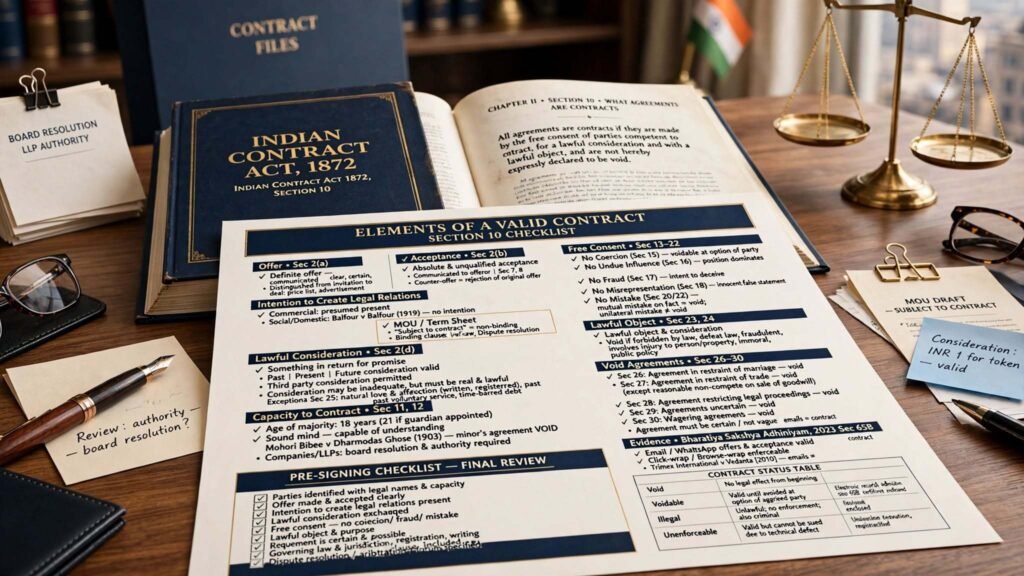
The elements of a valid contract in India come from one sentence in Section 10 of the Indian Contract Act, 1872: an agreement becomes a contract when it is made with the free consent of parties who are competent to contract, for a lawful consideration and with a lawful object, and is not one the Act expressly declares void. Offer and acceptance sit underneath that sentence, because without them there is no agreement to test.
That is the textbook list of the elements of a valid contract, and you can recite it from memory and still sign a bad deal. This guide walks through each of the elements of a valid contract the way a lawyer checks a contract before it matters: what the section says, where founders and small businesses actually trip, and what courts have said. It also covers the parts of the elements of a valid contract that most guides leave out, such as WhatsApp and click-wrap contracts, what “intention to create legal relations” means for an MOU or term sheet, and the difference between a contract that is void, one that is voidable and one that is simply unenforceable because nobody paid stamp duty.
The short version. The elements of a valid contract are a proposal and an unqualified acceptance, an intention to be legally bound, lawful consideration, parties with capacity, free consent, a lawful object, terms that are certain and possible to perform, and compliance with any formality the law adds for that type of deal, such as stamping or registration.
From agreement to contract: the elements of a valid contract at a glance
The Act defines an agreement as a promise or set of promises forming consideration for each other (Section 2(e)), and a contract as “an agreement enforceable by law” (Section 2(h)). Every contract is an agreement, but plenty of agreements are not contracts. A promise to meet a friend for dinner is an agreement. Nobody can sue over it.
Here are the elements of a valid contract in one place. The sections after this one take each in turn.
| Element | Where it comes from | The question to ask |
|---|---|---|
| Offer (proposal) | Section 2(a) | Did one side clearly state terms and signal willingness to be bound? |
| Acceptance | Sections 2(b), 7, 8 | Did the other side agree to exactly those terms? |
| Intention to create legal relations | Implied from Section 2(h) | Did both sides mean this to be enforceable? |
| Lawful consideration | Sections 2(d), 23, 25 | What did each side give or promise, and is it lawful? |
| Capacity | Sections 11 and 12 | Are both parties old enough, of sound mind and not disqualified? |
| Free consent | Sections 13 to 22 | Was any party forced, pressured, deceived or mistaken? |
| Lawful object | Sections 23 and 24 | Is the purpose legal and not against public policy? |
| Certainty and possibility | Sections 29 and 56 | Are the terms clear enough to enforce, and can they be performed? |
| Not declared void, and formalities met | Sections 10, 26 to 30 | Does another law forbid it or demand writing, stamping or registration? |
Elements of a valid contract, 1: offer, what counts and what does not
Section 2(a) says a person makes a proposal when he signifies his willingness to do or abstain from doing something, with a view to obtaining the other’s assent. Of all the elements of a valid contract, this one fails most often through vagueness. Three working rules follow.
It must be definite. “I might sell my flat for around ₹80 lakh if the mood is right” is a conversation. “I will sell my flat at Plot 14 for ₹80 lakh, payable within 30 days” is an offer. The more terms you leave open, the less likely a court treats your words as an offer at all.
An invitation to deal is not an offer. A price tag in a shop, a catalogue, an advertisement or a tender notice usually invites others to make offers. The shop can refuse your ₹500 for the item priced at ₹50, or for that matter the item priced at ₹5,000. A statement that promises a reward to anyone who performs a stated act is different. It can be a general offer that anyone can accept by doing what it asks.
It must be communicated and it can end. Under Section 4 a proposal is complete when it comes to the knowledge of the person it is made to. It can be revoked until the other side has accepted (Section 5), and it lapses on rejection, on a stated deadline, or after a reasonable time. A counter-offer counts as a rejection of the original, which is why “yes, but at ₹75 lakh” kills the first offer and starts a new one.
Elements of a valid contract, 2: acceptance
Section 7 sets the test: acceptance must be absolute and unqualified, and expressed in some usual and reasonable manner unless the offer prescribes one. Two points catch people.
“Yes, subject to” is not acceptance. If you reply “agreed, but payment in 60 days instead of 30”, you have made a counter-offer. Many commercial disputes begin with two sides who each believe they accepted, because each edited the other’s draft in a different email.
Silence is generally not acceptance. “If I don’t hear from you by Friday, I’ll take it you agree” does not bind the other person. Conduct can be acceptance though. Section 8 says performing the conditions of a proposal, or accepting a benefit under it, is acceptance. If a vendor ships what you ordered and you use it, you will find it hard to deny the contract.
When and where is a contract formed? Under Section 4, acceptance is complete as against the proposer when it is put in the course of transmission to him, and as against the acceptor when it comes to the proposer’s knowledge. For instantaneous communication such as the telephone, the Supreme Court has treated the contract as formed where the acceptance is received (Bhagwandas Goverdhandas Kedia v. Girdharilal Parshottamdas, 1966). That decides which court has jurisdiction when the contract is silent, which is one reason a clear jurisdiction clause matters.
A note on Lalman Shukla v. Gauri Dutt (1913). Textbooks cite this case for the rule that you cannot accept an offer you do not know about. Gauri Dutt’s clerk searched for his missing nephew, and the handbill offering a reward came after he left. A closer reading of the judgment shows the court found the handbill had reached him, and ruled against him because he was already under a duty to search. So the knowledge point was a side remark, and the pre-existing duty point was the actual reason. It is a small example of why you read the judgment and not just the headnote.
Elements of a valid contract, 3: intention to create legal relations
The Indian Act does not name this element, but courts treat it as part of what makes an agreement “enforceable by law”. The usual English cases come with it. In Balfour v. Balfour (1919), a husband’s promise of a monthly allowance to his wife was a domestic arrangement and unenforceable. Social and family promises are presumed not to be legal, and commercial deals are presumed to be.
For founders, the real difficulty is documents that sit in between: the MOU, the letter of intent, the term sheet and the “heads of terms”. Courts look at the wording and the conduct, not the title. Phrases such as “subject to contract”, “non-binding” and “subject to definitive agreement” point toward no intention to be bound on those terms, and a well-drafted term sheet usually says which clauses do bind (confidentiality, exclusivity, costs) and which do not. If you want something to bind, say so. If you do not, say that too. Our contract law glossary explains terms like MOU and term sheet in plain language.
Elements of a valid contract, 4: lawful consideration
Of all the elements of a valid contract, this is the one people find strangest, because the law of consideration in India differs from English law in a few places.
Section 2(d) says that when, at the desire of the promisor, the promisee or any other person has done or abstained, or does or abstains, or promises to do or abstain, from something, that act or promise is consideration. Four points follow from the wording.
- It can be past. “Has done” means Indian law accepts past consideration, provided the act was done at the promisor’s desire. English law generally does not.
- It can come from a third party. The promisee need not be the one who supplied it. The Madras High Court said so in Chinnaya v. Ramayya (1882). But the person who sues on the contract must still be a party to it. A stranger to the contract cannot ordinarily enforce it, subject to a few exceptions.
- It need not be adequate. Explanation 2 to Section 25 says an agreement is not void just because the consideration is inadequate. A court will not rewrite a bad bargain. It may still look at inadequacy when asking whether consent was free.
- It must be real and lawful. A promise to do something you are already legally bound to do is weak consideration. A promise to do something illegal is no consideration at all (Section 23).
When no consideration is needed: Section 25
Section 25 says an agreement missing consideration, one of the elements of a valid contract, is void, with three exceptions.
| Exception | Conditions |
|---|---|
| Natural love and affection | Must be in writing, registered, and between parties who stand in a near relation to each other |
| Compensation for past voluntary service | A promise, usually written, to compensate someone for something they did voluntarily for the promisor |
| Promise to pay a time-barred debt | Must be in writing, signed by the person making it, and promise to pay the debt or part of it |
For the second exception, courts have read “voluntarily” narrowly, so work done at the promisor’s request does not fall under it. That is a different route, through Section 2(d). A related, practical point for founders: equity or fees promised after the work is done are only safe if you document that the work was requested, and what was promised in return. I see this problem mostly in promised ESOPs and “we’ll sort you out later” arrangements, and our guide to ESOPs for startups covers how to paper the equity side.
Elements of a valid contract, 5: capacity of the parties
Section 11 says every person is competent to contract who is of the age of majority, of sound mind, and not disqualified by law. The age of majority is 18 under the Indian Majority Act, 1875, or 21 where a guardian has been appointed by a court or the person is under the Court of Wards.
Minors. In Mohori Bibee v. Dharmodas Ghose (Privy Council, 1903), a minor mortgaged his house to a moneylender for ₹20,000. The Privy Council held that a minor’s contract is void from the start, so he did not have to repay. Three consequences matter in practice. A minor cannot be bound by a contract, even if he lied about his age. He cannot ratify it on turning 18. But a contract made by a guardian for the minor’s benefit can be valid, and the minor can be a beneficiary. If you deal with a freelancer, creator or intern who may be under 18, get a guardian’s signature, and know that the contract still cannot be enforced against the minor.
Unsound mind. Section 12 asks whether the person understood the contract and could judge its effect on his interests at the time of making it.
Companies, LLPs and firms. They contract through people. Before signing with a company, check that the signatory is authorised by a board resolution or a power of attorney, and for large deals keep a copy on file. A contract signed by someone without authority creates a dispute about who is bound.
Elements of a valid contract, 6: free consent
Free consent is one of the elements of a valid contract that courts examine most closely. Section 14 says consent is free when it is not caused by coercion, undue influence, fraud, misrepresentation or mistake. If it was, the effect depends on which one.
| Defect | Section | What it means | Effect |
|---|---|---|---|
| Coercion | 15 | Committing or threatening an act forbidden by the Indian Penal Code (now the Bharatiya Nyaya Sanhita), or unlawfully detaining property, to force an agreement | Voidable at the option of the person coerced |
| Undue influence | 16 | One party is in a position to dominate the other’s will and uses it unfairly | Voidable |
| Fraud | 17 | A false statement made knowingly, or active concealment, or a promise made with no intention of performing it, to induce the contract | Voidable |
| Misrepresentation | 18 | A false statement made innocently, or a breach of duty that gains an advantage by misleading | Voidable |
| Mistake of both parties on a fact essential to the agreement | 20 | Both parties mistaken about a matter of fact that is essential | Void |
| Mistake of one party | 22 | Only one party is mistaken | Contract is not voidable on that ground alone |
Two points to take from the table on free consent, the trickiest of the elements of a valid contract. First, “voidable” means the contract stays valid until the victim chooses to cancel it, and they must do so promptly. A person who finds out about the fraud and keeps taking the benefit may lose the right. Second, mere silence is usually not fraud, but Section 17 says silence can be fraud where the person has a duty to speak, or where silence is itself equivalent to speech. A founder who knows a key customer is leaving and says nothing during a funding round is at risk.
Elements of a valid contract, 7: lawful object
Section 23 says the consideration or object is lawful unless it is forbidden by law, would defeat the provisions of any law, is fraudulent, involves or implies injury to a person or property, or is immoral or opposed to public policy. An agreement with an unlawful object is void. If part of the consideration or object is unlawful, Section 24 makes the whole agreement void, unless the lawful part can be separated.
Several agreements are expressly declared void, and Section 10 excludes them from the definition of a contract.
- Restraint of marriage (Section 26).
- Restraint of trade (Section 27): an agreement that restrains someone from carrying on a lawful profession, trade or business is void. This is why post-employment non-competes are so hard to enforce in India, and why drafting them carefully matters. See our guides on the bad leaver clause and trade secret protection in India.
- Restraint of legal proceedings (Section 28), including clauses that cut the limitation period.
- Uncertain agreements (Section 29).
- Wagering agreements (Section 30).
Elements of a valid contract, 8: certainty and possibility of performance
Section 29 says an agreement is void if its meaning is not certain or capable of being made certain. “We will agree a fair price later” fails unless there is a method to fix it. “Price will be the average of the two registered valuers’ valuations” passes, because it can be made certain. Section 56 says an agreement to do something impossible in itself is void. Founders mostly hit this in “agreements to agree”: an MOU that promises to sign a final deal on terms still to be negotiated.
Elements of a valid contract, 9: formalities, stamp duty and registration
Among the elements of a valid contract, writing is the odd one out: India has no general rule that a contract must be in writing. A verbal contract can be valid, though it is hard to prove. Section 10 adds that nothing in it affects any other law requiring writing, witnesses or registration. So the last of the elements of a valid contract you check often decides whether you can enforce at all.
| Type of agreement | Formality |
|---|---|
| Sale of immovable property | Written, stamped and registered |
| Lease of immovable property for more than a year | Written, stamped and registered |
| Gift of immovable property | Written, stamped and registered |
| Arbitration agreement | Must be in writing |
| Most business contracts | Not required by law to be in writing, but stamp duty applies to the written instrument under the relevant state law |
An unstamped or insufficiently stamped document is generally inadmissible as evidence until the duty and penalty are paid. The courts have treated that defect as curable, not fatal, but it adds cost and delay. Stamp duty varies by state, so check yours before you sign. Our guides on rent agreement versus lease agreement and the commercial lease agreement show how this works for property documents.
Elements of a valid contract in digital deals: email, WhatsApp, click-wrap and e-sign
Most start-ups now contract online. The same elements of a valid contract apply online. What changes is the proof.
- Section 10A of the IT Act, 2000 says a contract is not unenforceable only because electronic form or means were used in forming it.
- Emails can form a contract. In Trimex International v. Vedanta Aluminium, as reported, the Supreme Court inferred a concluded contract from an exchange of emails even without a signed document.
- Chats can too, if all the elements of a valid contract are present: offer, acceptance, consideration and intention. The risk is ambiguity: a thumbs-up emoji after a long thread is a weak foundation for a contract, and “ok” in reply to a draft with open points may not be unqualified acceptance.
- Click-wrap agreements, where the user clicks “I agree”, are the usual way online terms are accepted, and they are generally treated as stronger than browse-wrap, where use alone is said to imply consent. If you run a platform, our guide to the difference between terms of service and a privacy policy explains what to put in each.
- Electronic signatures are recognised, but the IT Act excludes some documents from electronic execution, including negotiable instruments, powers of attorney, trust deeds, wills, and contracts for the sale or conveyance of immovable property.
- Evidence. Electronic records are admitted with a certificate under the evidence law. The old Section 65B of the Evidence Act has been carried into the Bharatiya Sakshya Adhiniyam, 2023 (Section 63, as I read it). Keep the original emails, headers and logs, and do not rely on screenshots alone.
Void, voidable, illegal and unenforceable: when the elements of a valid contract are missing
These words get used loosely when people talk about the elements of a valid contract. They mean different things.
| Term | Meaning | Example |
|---|---|---|
| Void agreement (Section 2(g)) | Not enforceable by law, from the start | A minor’s agreement; a wager; an agreement in restraint of trade |
| Voidable contract (Section 2(i)) | Enforceable only at the option of one party | A contract induced by fraud or coercion |
| Illegal agreement | Forbidden by law, and it can taint related transactions | A contract to commit an offence |
| Unenforceable contract | Valid, but cannot be enforced for a technical reason until fixed | An unstamped agreement; a claim that is time-barred |
A pre-signing checklist of the elements of a valid contract
Before you sign or send anything, run through these elements of a valid contract.
- Who exactly are the parties, and do they have authority? Get the legal names, not the brand names.
- Is there a clear offer and a clean acceptance, or are two sets of edited drafts still circulating?
- Is it meant to bind? Mark clearly which parts of an MOU or term sheet are binding.
- What does each side give? Write the consideration down, including equity, fees, milestones and who pays what by when.
- Is anyone under pressure or misinformed? Record disclosures made in funding and sale discussions.
- Is the object lawful, and have you tested any non-compete or exclusivity against Section 27?
- Are the terms certain? Replace “reasonable” and “to be agreed” with a method or a number.
- What formalities apply? Stamp it, register it if needed, and sign in a way that can be proved.
- Where will disputes go? Name the governing law, the forum and the notice process. The legal checklist for Indian startups is a good companion.
- Are there guarantees? A personal guarantee is its own contract with its own consideration questions. Read the personal guarantor trap first.
Common mistakes with the elements of a valid contract
- Treating a thread of emails as “just discussion” and then acting on it.
- Signing a document whose edits did not match what was agreed.
- Using one party’s template without checking it against your deal.
- Promising equity or fees after the work is done with nothing in writing.
- Taking a non-compete from an employee and expecting it to be enforceable after they leave.
- Leaving signature authority unchecked on the other side.
- Forgetting stamp duty.
- Assuming a vendor’s standard terms protect you from AI-model risk, when the AI indemnity trap shows the indemnity may not cover what you think.
- Waiting for a dispute to find out what the contract says. The real cost of a gap shows up when you are chasing a payment, as our guide to what to do when a client refuses to pay explains.
If you want the elements of a valid contract checked in a draft before you sign it, you can reach out here, and the startup legal section lists related guides. Freelancers can start with the freelance agreement clauses article.
Frequently asked questions on the elements of a valid contract
1. What are the essential elements of a valid contract in India?
Under Section 10 of the Indian Contract Act, 1872, the elements of a valid contract are free consent, parties competent to contract, a lawful consideration, a lawful object, and the agreement not being one the Act expressly declares void. In practice, you also need an offer and acceptance, an intention to create legal relations, terms that are certain and possible, and compliance with formalities such as stamping or registration.
2. What is the difference between an agreement and a contract?
An agreement is a promise or set of promises forming consideration for each other (Section 2(e)). A contract is an agreement enforceable by law (Section 2(h)). All contracts are agreements, but not all agreements are contracts. A social arrangement or an agreement without consideration is an agreement that the law will not enforce.
3. Can consideration, one of the elements of a valid contract, be past in India?
Yes. Section 2(d) uses the words “has done or abstained”, so an act done in the past at the promisor’s desire can be consideration. This differs from English law. The act must have been done at the promisor’s request, and a separate exception in Section 25 deals with past voluntary services, which needs a written promise.
4. Is an agreement without consideration valid?
Generally no, it is void under Section 25. There are three exceptions: a written and registered promise made out of natural love and affection between near relations, a promise to compensate for past voluntary service, and a written and signed promise to pay a time-barred debt.
5. Does a minor meet the elements of a valid contract in India?
No. Under Mohori Bibee v. Dharmodas Ghose (1903), a minor’s agreement is void from the start. A minor cannot be held to it, and cannot ratify it after turning 18. A contract made by a guardian for the minor’s benefit can be valid, and a minor can be a beneficiary of a contract.
6. Does a WhatsApp message or email satisfy the elements of a valid contract?
It can be, if it has all the elements: a clear offer, an unqualified acceptance, consideration, intention to be bound and a lawful object. Section 10A of the IT Act says a contract is not unenforceable only because it was formed electronically. Proof is the difficulty, so keep the originals and agree key terms in a clear document.
7. Is writing one of the elements of a valid contract in India?
Not generally. A verbal contract can be valid. But some contracts must be in writing, and often stamped and registered, such as sales of immovable property and leases above a year. An arbitration agreement must be in writing. And a written contract that is not properly stamped cannot be used in evidence until the defect is cured.
8. What happens when the elements of a valid contract are missing: void or voidable?
A void agreement is not enforceable from the start, for example a minor’s agreement or a wager. A voidable contract is valid until the aggrieved party chooses to avoid it, for example where consent was obtained by fraud, coercion, undue influence or misrepresentation. The victim has to act promptly, or they may lose the right.
9. Do click-wrap agreements meet the elements of a valid contract in India?
Generally yes, where the user is shown the terms and takes a positive step such as clicking “I agree”. They are treated as stronger than browse-wrap terms, where use of a site is said to imply consent. Enforceability still depends on the terms being clear and not being unfair or unlawful.
10. Does a non-compete clause meet the elements of a valid contract?
During the contract, restrictions that protect legitimate interests are often enforceable. After the relationship ends, Section 27 makes an agreement that restrains a person from carrying on a lawful trade or profession void, so broad post-termination non-competes are very difficult to enforce. Protect confidential information through confidentiality and trade-secret clauses instead.
This article is general information, not legal advice. The law and the way courts apply it change, and your documents have their own facts. Speak to a qualified lawyer before relying on any point here.
Sources: Lawsection, Essential Elements of a Valid Contract (2026); The Legal School, Section 10 of the Indian Contract Act; IndiaCorpLaw, Lalman v Gauri Dutt: Legend and Reality; iPleaders, Landmark judgments on contracts with minors; Casemine, A critical analysis of Section 25 of the India