
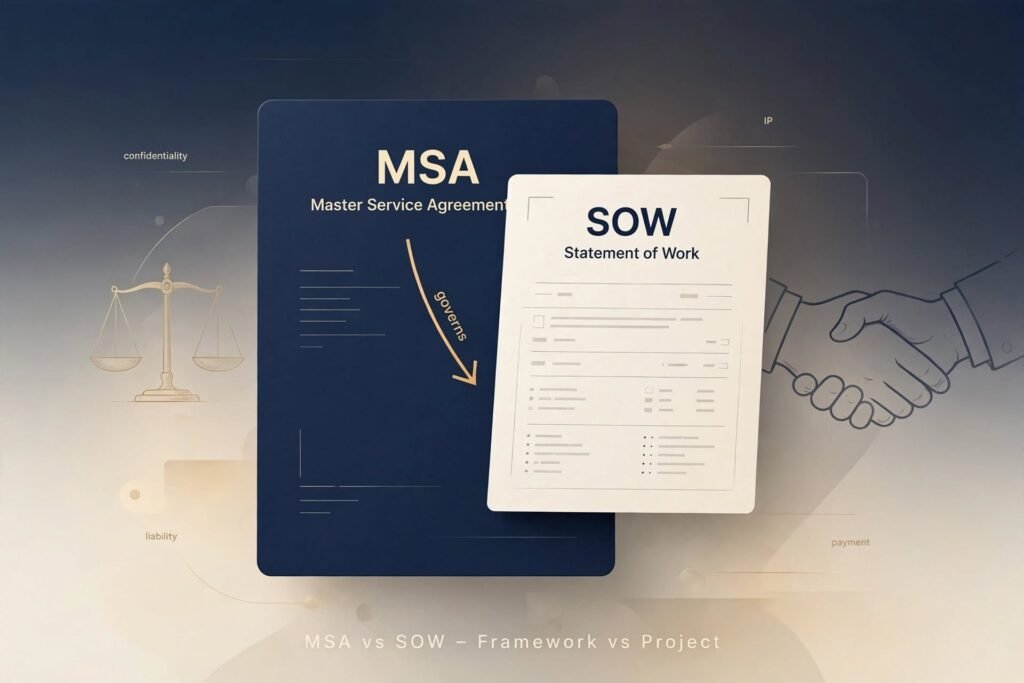
MSA vs SOW looks like paperwork trivia until a delivery slips, an invoice is disputed, and someone asks which document says what, and which one wins when the two disagree.
The short version: a master service agreement (MSA) is the standing legal framework between two companies. It deals with the things that do not change from project to project: confidentiality, liability, IP, payment mechanics, termination and how disputes get resolved. A statement of work (SOW) is the project-specific document that sits underneath it and says what will be delivered, by when, for how much, and how you will know it is done. One MSA, many SOWs.
That is the textbook MSA vs SOW answer, and every competitor article I read gives it. What most of them skip about MSA vs SOW is what actually causes trouble in India: which document wins in a conflict (most don’t say), how a missing line in an SOW can quietly cut your ownership of the code to five years in India only, whether the arbitration clause in the MSA reaches the SOW, and how stamp duty works when you sign a new SOW every month. This guide covers the MSA vs SOW question the way I handle it for clients, with sample clauses, a worked example, a skeleton SOW, and ten FAQs.
MSA vs SOW at a glance
| Master service agreement (MSA) | Statement of work (SOW) | |
|---|---|---|
| Purpose | Sets the rules of the relationship | Defines one project or engagement |
| Signed | Once, at the start | For each new project or phase |
| Typical contents | Confidentiality, IP framework, liability cap, indemnity, payment mechanics, termination, governing law, dispute resolution | Scope, deliverables, milestones, timeline, fees, team, acceptance criteria, assumptions, change process |
| Duration | Long, often 1 to 3 years with renewal | Ends when the project ends |
| Who negotiates it | Legal and senior management | Project owners with legal review |
| How often it changes | Rarely | Constantly |
| Can it stand alone? | Yes, but it commits no one to buy anything | Only if it carries its own full terms or refers to an MSA |
| Legal status in India | An ordinary contract under Section 10 of the Contract Act, 1872 | Also a contract, normally incorporating the MSA by reference |
There is no Indian statute that creates an MSA or an SOW, so the MSA vs SOW structure is pure contract. Both are ordinary contracts, and the law that applies is the Indian Contract Act, 1872, plus the Copyright Act, the Stamp Act, the Arbitration and Conciliation Act and whichever sector rules apply to the work. The structure is a commercial convention, not a legal category, which is why the drafting is everything.
MSA vs SOW: what belongs in the MSA
Put in the MSA anything that you would not want to renegotiate for every project.
- Definitions and the SOW mechanism. How an SOW is created, who signs it, and that each SOW incorporates the MSA.
- Order of precedence. Which document prevails (more on this below).
- Confidentiality and data protection. Including any processing terms; see our guide to DPDP contract clauses.
- IP framework. What the customer owns, what the vendor keeps, how background and foreground IP are treated.
- Payment mechanics. Invoicing, due dates, late payment, taxes. Rates and fees go in the SOW.
- Warranties, liability and indemnity. See our articles on the limitation of liability clause and the indemnification clause, and decide whether the cap is per SOW or aggregate.
- Force majeure. Our guide to the force majeure clause covers listed events, notice and termination.
- Term, suspension and termination, including what happens to open SOWs when the MSA ends.
- Dispute resolution, governing law and jurisdiction.
- Boilerplate. Notices, assignment, entire agreement, severability, independent-contractor status.
MSA vs SOW: what belongs in the SOW
A good SOW is boring and specific. If a stranger could not tell from it what was promised, it is not finished.
- Scope and objectives. What is in, and just as importantly, what is out.
- Deliverables and specifications. Each one named, with a description and format.
- Milestones and timeline. Dates or durations, and dependencies on the customer (access, data, approvals).
- Fees and payment schedule. Fixed price, time and materials or milestone-based, with the invoice triggers.
- Acceptance criteria. How the customer tests and accepts, in how many days, and what deemed acceptance means.
- Team and roles. Key personnel and any restrictions on replacing them.
- Assumptions and exclusions. The things the price depends on.
- Change control. How changes are requested, priced and approved.
- Project-specific IP and data terms. Any assignment, licence or processing details that differ from the MSA.
- Reference to the MSA. The date and parties, and a statement that the MSA governs.
MSA vs SOW: which one prevails? The order of precedence clause
This is the question most MSA vs SOW articles skip. Competitor guides such as SpotDraft’s explain what each document is and say nothing about what happens when they disagree. One US law firm article on conflicts says, without citing a case, that without a clear hierarchy a court may treat the MSA as controlling the broad obligations and the SOW as supplementing operations, and then in another section suggests the SOW may win as the later and more specific document. That is the problem: the default is unpredictable, and you should not rely on it.
In any MSA vs SOW structure, write the rule down. The usual wording is:
“In the event of any conflict between this Agreement and an SOW, the terms of this Agreement shall prevail, except where the SOW expressly states that it is intended to override a specific clause of this Agreement by reference to the clause number, and is signed by an authorised signatory of each party.”
That sentence does three things. It makes the MSA the default winner, so a casual line in a project document cannot rewrite your liability cap. It allows a deliberate, visible override. And it requires the override to be express and signed, so a project manager’s template does not do it by accident.
In MSA vs SOW drafting, choose the opposite rule (SOW prevails) only if the MSA is a thin framework and the real commercial terms sit in each SOW, for example a very large customer with a standard MSA. Even then, restrict the SOW’s power to override particular matters such as liability, IP and data protection.
Two more points.
- Conflicts between SOWs. If you have several SOWs under one MSA, say whether later SOWs supersede earlier ones for the same work. Without it, an older SOW’s pricing can resurface.
- Interpretation, not just precedence. In MSA vs SOW terms, a precedence clause tells you which document wins when there is a conflict. It does not help if the two documents are merely inconsistent in a way that is not a direct contradiction. Use consistent defined terms in both.
A worked MSA vs SOW example
A Pune software firm signs an MSA with a retail customer. The MSA caps the firm’s liability at fees paid in the last 12 months and excludes indirect loss. Six months later they sign SOW 3 for a loyalty app. The customer’s procurement team uses its own SOW template, and one line in the template says “Vendor shall be liable for all losses arising from delays.” The app launches three weeks late during a sale, and the customer claims ₹60 lakh in lost sales.
- With no precedence clause, the customer argues the SOW is later and more specific, so the cap does not apply to delay. The vendor argues the MSA governs. Both arguments are plausible, and the dispute is expensive.
- With the precedence clause above, the MSA wins unless the SOW identifies the clause it overrides by number. The template line does not, so the cap and exclusion survive.
The clause does not make the claim disappear, but it turns an open argument into a short one.
The MSA vs SOW IP trap: how a silent SOW can cut your ownership to five years
This is the MSA vs SOW point with the most money behind it, and it is specific to India.
Under the Copyright Act, 1957, an employer is generally the first owner of copyright in works an employee creates in the course of employment (Section 17(c)). A contractor, consultant or agency is not an employee, so copyright in what they create generally stays with them unless it is assigned. That makes the assignment clause in your MSA and SOW the thing that decides who owns the code, designs and content.
Section 19 sets the formalities for that assignment. It should be in writing, signed by the assignor, identify the work and the rights, and state the duration and territorial extent. Where the duration is not stated, Section 19(5) deems it to be five years. Where the territory is not stated, Section 19(6) presumes it to be India only. Under Section 19(4), rights that the assignee does not exercise within one year are deemed to lapse unless the contract says otherwise.
The case that shows this MSA vs SOW problem in a master agreement and work order setting is Pine Labs Pvt. Ltd. v. Gemalto Terminals India Pvt. Ltd. (Delhi High Court, Division Bench, 3 August 2011). The parties had a master agreement with an IP clause stating that the vendor “assigns” rights, and a work order. Neither the MSA nor the work order stated a duration or territory. The Division Bench read “assigns” as a present assignment, then applied the deeming rules: five years, India only. It said Parliament introduced those defaults in 1994 to prevent unintended perpetual assignments, and that courts should not infer permanence from silence. It restored the injunction on a prima facie basis.
Later cases show it is not mechanical. In Dorling Kindersley (Delhi High Court, 2013), the court said Section 19(5) cannot be read in isolation and the parties’ intention must be found from the contract as a whole. In Shemaroo (Delhi High Court, 2012), words such as “absolutely”, “perpetually”, “for the full term of copyright” and “worldwide” pointed to a long-term transfer and the default did not apply. Saregama (Calcutta High Court, 2018) and Ghanshyam Hemdev (Madras High Court, 2023) took the same approach. The lesson across them is that Section 19(5) is a protective default for silent or ambiguous contracts. It does not override clear words.
So what to do:
- State duration and territory expressly in the MSA assignment clause, for example “for the full term of copyright, throughout the world”.
- Say whether each SOW’s deliverables are assigned or licensed, and tie assignment to payment if you want leverage.
- Separate background IP (the vendor keeps it, the customer gets a licence) from foreground IP (assigned).
- Add moral rights language. Authors keep moral rights under Section 57 even after assignment, and blanket waivers are of doubtful effect, so address reasonable editing and attribution instead.
- Check that the vendor owns what it is assigning, including from its own contractors.
- Keep the SOW consistent. An SOW that says “work product vests in the customer” without the Section 19 details is a way of sliding back into the five-year problem if the MSA is not clearly incorporated.
Patents follow a different path, because the Patents Act, 1970 has no automatic vesting rule for employee inventions, so assignments of inventions need their own paperwork. If you are the vendor, these same points protect your background IP. For related IP issues see our guides on trade secrets law for founders and the AI indemnity trap.
MSA vs SOW and arbitration: does the MSA’s clause reach the SOW?
Usually yes, but only if you make it. An SOW that is signed separately and refers only to “the Services” has to be tied back to the MSA. Section 7(5) of the Arbitration and Conciliation Act, 1996, says a reference in a contract to a document containing an arbitration clause makes an arbitration agreement if the contract is in writing and the reference makes that clause part of the contract. In practice, put in every SOW: “This SOW is governed by, and incorporates by reference, the Master Service Agreement dated [date], including its dispute resolution clause.”
The Supreme Court’s decision in Dresser Rand v. Bindal Agro Chem (2006), covered in our guide to MOU vs contract vs letter of intent, shows what happens when documents do not link: letters of intent that did not incorporate the arbitration clause did not create an arbitration agreement. Do not repeat that mistake with an SOW.
Also name the seat, venue, number of arbitrators, rules and language in the MSA, and decide whether SOW disputes go through the same ladder (escalation, mediation, arbitration).
MSA vs SOW: stamp duty and signing
Stamp duty is a state subject under the Indian Stamp Act, 1899 and state schedules, so there is no single rate. For an MSA and SOW structure, the practical questions are:
- Which state’s rules apply? An instrument executed in one state and used in another can attract additional duty. Check where you sign and where the document is used.
- Does each SOW need stamping? It depends on the state and the content. An SOW that creates new obligations may be treated as an instrument in its own right. Ask your local counsel for a rule that fits your volume of SOWs, and write it into your process.
- What if it is unstamped? Under Section 35 of the Stamp Act, an unstamped or insufficiently stamped instrument is inadmissible in evidence until duty and penalty are paid. The defect is curable. In the seven-judge decision on the interplay between arbitration agreements and the Stamp Act (2023), the Supreme Court held that an unstamped agreement is not void and that the arbitration clause survives, as one commentator on MSAs notes. I have not re-read the judgment, so check it before relying on it.
- E-signatures. The Information Technology Act, 2000 recognises electronic signatures, with exclusions listed in its First Schedule. Many parties sign MSAs and SOWs electronically; confirm that the signatory has authority and that the stamping route (physical or e-stamp) matches the state’s rules.
Authority matters as much as stamping. An SOW signed by a project manager who has no authority to bind the company is a standing invitation to an argument. Put a signatory matrix in the MSA: who can sign SOWs, and up to what value.
MSA vs SOW change orders: where scope creep becomes a dispute
Most MSA vs SOW disputes are really change disputes. The customer says the extra work was part of the scope, and the vendor says it was extra. A clear change order process is the cheapest insurance there is.
A workable MSA vs SOW change process:
- A change is requested in writing by either party.
- The vendor assesses the impact on scope, price, timeline and resources within a fixed number of days.
- No change takes effect until a written change order is signed by authorised signatories of both parties.
- Work done on an unsigned request is at the requester’s risk, unless the parties have agreed an emergency procedure.
- Each change order is numbered, dated and attached to the SOW.
Under the Indian Contract Act, parties can alter a contract by agreement (Section 62), and a clean written change order is the best evidence of that agreement. A chain of emails saying “yes, go ahead” is evidence too, but you will be arguing about it.
MSA vs SOW payment, taxes and MSME customers
In MSA vs SOW drafting, put payment mechanics in the MSA and the numbers in the SOW. Two Indian points deserve a line in the MSA.
- Taxes. Say who bears GST, how TDS is handled, and how invoices and tax certificates are exchanged. The rates and the treatment depend on the nature of the service and current law, so confirm them with your tax adviser rather than copying a clause.
- MSME vendors. If a vendor is registered as a micro or small enterprise, the Micro, Small and Medium Enterprises Development Act, 2006 limits payment terms (generally 45 days where there is a written agreement, and 15 days if there is none) and provides for interest on delay, and Section 43B(h) of the Income-tax Act links the customer’s deduction to timely payment. A competitor article described this as simplified, and I agree it is, so confirm current rules before drafting payment terms. See our guide to MSME registration.
Common MSA vs SOW mistakes
An SOW with no reference to the MSA, the commonest MSA vs SOW gap. Without it, the SOW may stand alone and your liability cap, IP clause and arbitration clause may not apply.
An MSA that expires while SOWs are live. Say what happens: the MSA continues to govern SOWs signed before expiry until they finish.
Silent IP in the SOW. See the Section 19 discussion above.
Vague acceptance. “Customer shall review the deliverables” invites endless rejection. Give a review period, objective criteria, and deemed acceptance after the period.
Time and materials with no cap. Add a not-to-exceed amount or a notice when 80% of the estimate has been used.
Per-SOW and aggregate liability confusion. Decide whether the cap applies to each SOW or to the whole relationship, and say so.
Unclear termination. Can you terminate one SOW without ending the MSA? Can the vendor suspend for non-payment? State it.
Using an MSA with a freelancer who is really an employee. A label does not decide the relationship; see our article on worker misclassification and the guide to freelance agreement clauses.
Forgetting restraints. Keep exclusivity to the term of the engagement, since post-term restraints face Section 27 of the Contract Act. See the guide to the non-compete agreement in India.
MSA vs SOW in practice: a sample SOW skeleton
Statement of Work No. [ ] under the Master Service Agreement dated [ ] between [Customer] and [Vendor]
- Governing agreement. This SOW is governed by and incorporates the MSA, including its dispute resolution clause. In case of conflict, clause [x] of the MSA applies.
- Project summary and objectives.
- Scope of services and deliverables. [List each with description.]
- Out of scope. [List.]
- Timeline and milestones. [Dates, dependencies on Customer.]
- Fees and payment schedule. [Amount, basis, invoice triggers, taxes.]
- Acceptance. [Criteria, review period, deemed acceptance.]
- Personnel. [Key roles and replacement rules.]
- IP and data. [Assignment or licence for deliverables, duration and territory, data categories.]
- Assumptions and risks.
- Change control. [Process under clause [y] of the MSA.]
- Signatures. [Authorised signatories per the signatory matrix.]
MSA vs SOW: when you do not need an MSA
If you are buying one project and do not expect to repeat it, the MSA vs SOW structure is overkill and a single services agreement is simpler. An MSA earns its place when you expect several projects with the same counterparty, or when you want the legal terms agreed before the pressure of a specific project. A statement of work on its own, with no framework, is acceptable only if it contains the full legal terms. Many “SOWs” circulating between small businesses are really a one-page scope with no terms at all, and that leaves you with the Contract Act defaults. For the vocabulary, see our contract law glossary, and for a wider checklist, the legal checklist for Indian startups. If you would like a review of your own documents, contact us or browse the startup legal section.
Frequently asked questions
1. What is the difference in MSA vs SOW?
In MSA vs SOW terms, an MSA is the standing framework that governs the whole relationship (confidentiality, IP, liability, payment mechanics, termination, disputes). An SOW covers one project: scope, deliverables, timeline, fees and acceptance. In the MSA vs SOW structure, you sign the MSA once and a new SOW for each project.
2. In MSA vs SOW, which prevails?
Whichever the contract says. In MSA vs SOW disputes there is no reliable default, so include an order of precedence clause. The common approach is that the MSA prevails unless the SOW expressly overrides a numbered clause and is signed by authorised signatories.
3. In MSA vs SOW terms, can an SOW exist without an MSA?
Yes, but then the SOW must contain all the legal terms, because nothing else supplies confidentiality, liability, IP or dispute resolution. Without them, you rely on the Contract Act defaults, which rarely match what the parties assumed.
4. Is an MSA legally binding?
Yes, if it meets the requirements of Section 10 of the Indian Contract Act. But an MSA on its own usually does not commit either party to buy or deliver anything. The commitments to specific work are created by SOWs.
5. Do I need to stamp an MSA and each SOW in India under MSA vs SOW rules?
Stamp duty is a state matter, so it depends on the state and the content. An unstamped instrument is inadmissible until duty and penalty are paid but is not void. Ask local counsel how your state treats an MSA and a recurring SOW, and build the answer into your process.
6. Who owns the IP under MSA vs SOW documents in India?
Not automatically the customer. A contractor generally keeps copyright unless there is a written assignment that satisfies Section 19 of the Copyright Act. If duration and territory are not stated, the assignment is deemed to last five years and cover India only, as in Pine Labs v. Gemalto. State both expressly.
7. Does the arbitration clause in the MSA cover the SOW?
Only if the SOW incorporates the MSA by reference. Section 7(5) of the Arbitration and Conciliation Act, 1996 allows a clause in another document to become part of the contract by reference. Put the incorporation sentence in every SOW.
8. How do change orders work in an MSA vs SOW structure?
A written request, an impact assessment on price and time, and a signed change order before the work starts. Unsigned changes are at the requester’s risk. Number and attach each change order to the SOW.
9. Can one MSA cover multiple SOWs?
Yes, that is the point of an MSA vs SOW structure. Say whether liability caps apply per SOW or across all of them, whether later SOWs supersede earlier ones for the same work, and what happens to open SOWs if the MSA expires or is terminated.
10. In MSA vs SOW terms, what happens to SOWs when the MSA ends?
It depends on the survival and termination clauses. In MSA vs SOW drafting, a good MSA says that SOWs signed before expiry continue under the MSA’s terms until completed, unless the MSA is terminated for cause, in which case the customer may also terminate open SOWs.
This article is general information, not legal advice. Your contract and facts decide the answer, so get your documents reviewed before you rely on them.